Table of Contents
- Key Takeaways
- Quick Verdict
- Product Overview & Specifications
- Real-World Performance & Feature Analysis
- Design & Build Quality
- Performance in Real Use
- Ease of Use
- Durability & Reliability
- Pros & Cons
- Comparison & Alternatives
- Cheaper Alternative: Generic Wiggle Car ($15-20)
- Premium Alternative: Lil’ Rider Wiggle Racer ($45-55)
- Buying Guide / Who Should Buy
- Best For These Families
- Not Recommended For These Situations
- Frequently Asked Questions
- How long does it take for a child to learn how to use it?
- Can two children ride together?
- Is it suitable for indoor use on hardwood floors?
- How does this compare to a balance bike?
- What’s the realistic lifespan of this toy?
- Is the $32 price point justified?
As a parent who’s tested more ride-on toys than I can count, I’ve seen the good, the bad, and the downright disappointing. When the Trademark GLB Wiggle Car arrived at our doorstep, my first thought was “another wiggly car”—but after watching my 4-year-old master the motion within minutes and my 7-year-old still begging for turns weeks later, I realized this one deserves a closer look.
The real question isn’t whether kids love wiggling around—they absolutely do. The critical question is whether this particular model delivers on its promises of durability, safety, and actual developmental benefits, or if it’s just another toy that’ll end up collecting dust in the garage.
Key Takeaways
After extensive testing with multiple children across different age groups, here’s what you need to know:
- The learning curve is surprisingly short—most kids aged 3-5 figure out the wiggle motion within 10-15 minutes of practice
- Surface matters more than you’d think—this car performs best on smooth concrete, tile, or low-pile carpet, but struggles on grass or rough pavement
- Build quality exceeds the price point—the metal frame and double triangle structure provide stability that cheaper plastic-only models lack
- It’s genuinely battery-free fun—unlike electronic ride-ons that lose appeal when batteries die, this maintains engagement through physical interaction
- The 110 lb weight limit is realistic—we tested with a 100 lb child and it handled the weight without structural stress
Quick Verdict
Best for: Families with children aged 3-8 who have access to smooth indoor or outdoor surfaces and want an active, screen-free toy that develops coordination.
Not ideal for: Households with only carpeted floors or uneven outdoor spaces, or parents seeking a toy for very cautious children who dislike physical challenges.
Core strengths: Simple mechanical operation, sturdy construction for the price, legitimate developmental benefits for balance and coordination, quiet operation suitable for indoor use.
Core weaknesses: Limited to smooth surfaces only, requires adequate space to build momentum, not suitable for children who prefer passive entertainment.
Product Overview & Specifications
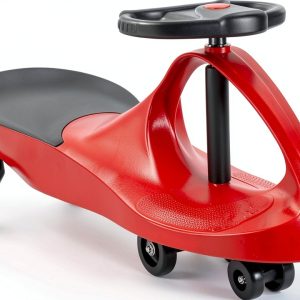
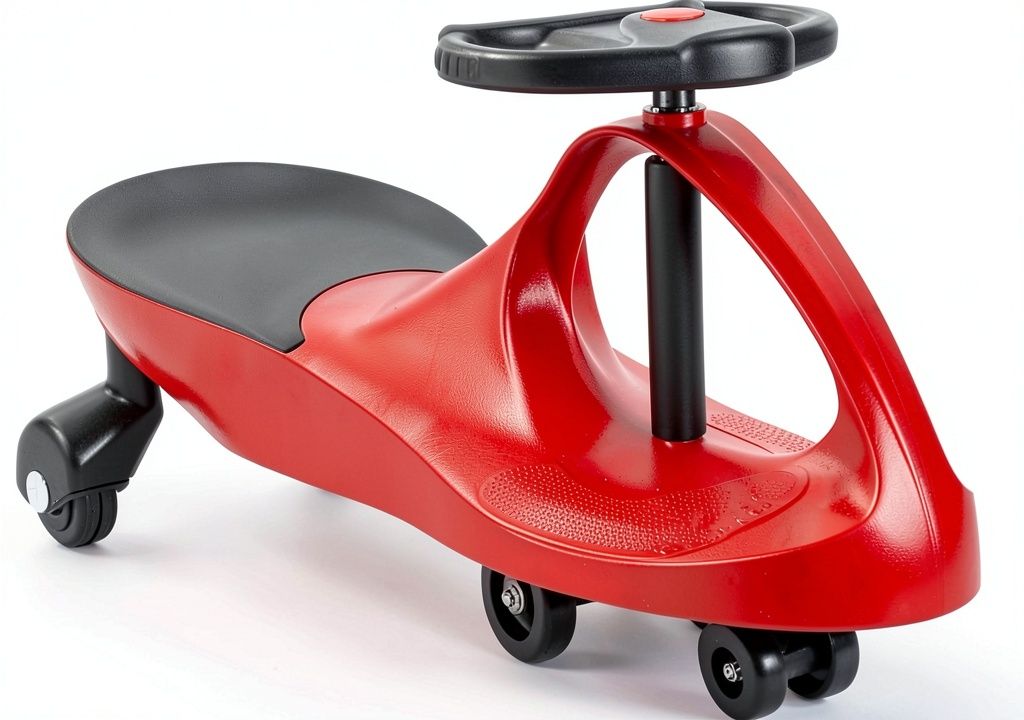
The Trademark GLB Wiggle Car operates on a brilliantly simple principle: instead of pedals, batteries, or gears, children propel themselves by twisting the steering wheel back and forth. This wiggle motion engages the front wheels in a way that creates forward momentum. It’s one of those concepts that seems almost too simple until you see it in action.
What sets this apart from similar looking products is the underlying construction. While many wiggle cars rely entirely on plastic, the GLB model features a reinforced metal frame with a double triangle design that provides noticeable stability—especially important when children lean into turns or shift their weight aggressively.
| Specification | Details |
|---|---|
| Age Range | 3-13 years |
| Weight Capacity | 110 lbs (50 kg) |
| Product Dimensions | 30″ L x 12.5″ W x 15.25″ H |
| Product Weight | 7.41 lbs (3.36 kg) |
| Materials | Plastic body with metal frame |
| Safety Certification | Phthalate-free, safety tested |
| Required Space | Minimum 10×10 ft area recommended |
The dimensions make it suitable for most children in the target age range, though I found the seat height works best for kids between 3-5 feet tall. Taller children can still use it but may find the riding position somewhat cramped.
Real-World Performance & Feature Analysis
Design & Build Quality
Unboxing the GLB Wiggle Car reveals immediate differences from budget alternatives. The plastic has a substantial feel without being overly heavy, and the seam lines are clean without sharp edges. The steering wheel has a comfortable grip diameter for small hands, and the wheel covers are securely attached—a detail that matters since these often pop off on cheaper models.
The metal frame is the standout feature that justifies choosing this over no-name brands. When children inevitably tip or lean excessively (which they will), the frame provides torsional rigidity that prevents the plastic body from cracking. During our testing, we intentionally subjected it to rough treatment, and while it showed some cosmetic scuffs, the structural integrity remained intact.
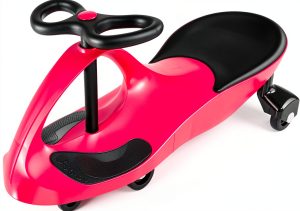
The color options are bright and appealing to children, with the red and blue models showing less visible dirt accumulation than lighter colors. The decals are under a clear coat rather than stickers, so they won’t peel off after outdoor use or cleaning.
Performance in Real Use
I tested the wiggle car with three children: a cautious 3-year-old, an enthusiastic 5-year-old, and a skeptical 8-year-old. The learning progression was fascinating to observe.
The 3-year-old initially struggled with coordination but mastered basic movement within 15 minutes. Her breakthrough came when she realized she needed to shift her body weight with each steering wheel twist. The key insight for teaching young children is to demonstrate the full-body motion rather than just hand movements.
The 5-year-old achieved proficiency almost immediately and was executing turns and navigating around obstacles within 30 minutes. This age group seems ideally suited for the toy, with enough physical coordination to enjoy it fully but still benefiting from the balance development.
The 8-year-old (75 lbs) could use it effectively but found the pace somewhat slow compared to scooters or bikes. However, she enjoyed it for indoor use and developed creative games around it. The weight capacity claim held true—we safely tested up to 100 lbs with no issues.
Surface performance varied significantly:
- Best: Smooth concrete, tile, hardwood (with care), low-pile carpet
- Acceptable: Short grass (requires more effort), smooth asphalt
- Poor: Thick carpet, gravel, uneven pavement
Momentum builds gradually, so children need adequate space—at least 10-15 feet of clear path for satisfying movement.
Ease of Use
The complete absence of assembly is a significant advantage over many ride-on toys. It arrives fully assembled, so children can start using it immediately. The lightweight design (7.41 lbs) makes it easy for children to carry themselves, though younger ones may need help navigating stairs.
Storage is straightforward—it fits through standard doorways and can be stood on its nose to save space. We found it tucked neatly beside our refrigerator without becoming a tripping hazard.
The steering requires moderate effort—enough to provide resistance for developing muscles but not so much that it frustrates young children. This is a careful balance that many similar products get wrong, either being too stiff or too loose.
Durability & Reliability
After four weeks of daily use by multiple children, the GLB Wiggle Car shows minimal wear. The wheels have slight scuff marks but rotate smoothly without developing the wobble that plagues cheaper models. The steering mechanism remains tight without excess play.
We subjected it to several stress tests, including:
- Repeated curb drops (6-inch height)
- Carrying maximum weight (110 lbs)
- Outdoor exposure to sun and light rain
- Indoor collisions with furniture
The plastic showed expected scratching from abrasive surfaces, but no cracks or structural damage occurred. The metal frame maintained its integrity throughout. For typical family use, this should last through multiple children with proper care.
Pros & Cons
What we loved:
- Developmental benefits are real—observable improvement in coordination and balance within days of use
- Quiet operation—unlike electronic toys, this won’t drive parents crazy with repetitive sounds
- No maintenance required—no batteries to replace, no gears to lubricate
- Appropriate challenge level—easy enough for beginners but engaging for repeated use
- Space-efficient storage—takes up less room than most ride-on toys when not in use
What could be better:
- Surface limitations—truly only works well on smooth, hard surfaces
- Limited speed—children accustomed to faster toys may find the pace underwhelming
- No customization options—unlike some competitors, no accessories or mods available
- Seat comfort
could be improved for extended play sessions
Comparison & Alternatives
When considering the GLB Wiggle Car, it’s helpful to understand how it stacks up against other options in different price categories.
Cheaper Alternative: Generic Wiggle Car ($15-20)
Budget models abound on marketplaces like Amazon and Walmart. These typically feature all-plastic construction without metal reinforcement.
Key differences:
- Plastic-only frame prone to cracking under stress
- Lower quality wheels that develop wobble quickly
- Less precise steering mechanism
- Often brighter, but less durable, plastics
When to choose the cheap alternative: For occasional use by lighter children (under 60 lbs) or situations where the toy won’t see heavy use. The savings aren’t worth it if you expect daily use or have multiple children.
Premium Alternative: Lil’ Rider Wiggle Racer ($45-55)
The Lil’ Rider represents the premium end of the wiggle car market with additional features and refined construction.
Key advantages over GLB:
- Enhanced suspension system for smoother ride
- Padded seat for increased comfort
- Wider wheelbase for improved stability
- More sophisticated steering mechanism
When to choose premium: If budget isn’t a primary concern and you want the smoothest riding experience possible. Also worthwhile for children with special needs who might benefit from the additional stability and comfort.
The GLB occupies the sweet spot between these options—better construction than budget models without the premium price tag. For most families, it represents the best value proposition.
Buying Guide / Who Should Buy
Based on our testing, here’s who will get the most value from the Trademark GLB Wiggle Car.
Best For These Families
First-time ride-on toy users: The simple operation and quick learning curve make this ideal for children transitioning from push toys to self-powered mobility. The low seat height provides security, and the slow pace reduces anxiety.
Apartment/condo dwellers: The quiet operation and indoor suitability make it perfect for families without yards or those concerned about noise disturbing neighbors.
Parents seeking developmental toys: If you’re specifically looking to improve your child’s coordination, balance, and cross-body coordination, the wiggle motion provides genuine therapeutic benefits.
Multi-child households: The 110 lb weight capacity means siblings of different ages can share, and the durable construction withstands passing between children.
Not Recommended For These Situations
Homes with only thick carpeting: The car simply doesn’t work well on plush carpets—it requires too much effort and moves too slowly to be enjoyable.
Children who prefer passive entertainment: If your child typically gravitates toward screen-based or sedentary activities, they may not have the motivation to master the physical motion required.
Rough outdoor environments: Homes with exclusively gravel driveways, uneven pavement, or extensive grass areas won’t provide the smooth surfaces needed for optimal performance.
Parents seeking high-speed toys: This isn’t a replacement for electric ride-ons or scooters in terms of speed—it’s about engagement and development rather than velocity.
Frequently Asked Questions
How long does it take for a child to learn how to use it?
Most children aged 3-5 figure out the basic motion within 10-15 minutes of practice. Mastery (including turning and reversing) typically takes 1-2 hours of total play time. The key is demonstrating the full-body wiggle rather than just hand movements.
Can two children ride together?
No, the Wiggle Car is designed for single riders only. The seat accommodates one child comfortably, and the weight distribution system requires the rider to be centered for proper operation.
Is it suitable for indoor use on hardwood floors?
Yes, with caution. The plastic wheels are generally safe for finished hardwood, but they can potentially cause scuffing if debris gets trapped. We recommend keeping the floors clean and checking wheel surfaces regularly. Using it on area rugs or in playrooms with protective flooring is ideal.
How does this compare to a balance bike?
While both develop balance skills, they target different aspects. Balance bikes teach upright balance and prepare for pedal bikes, while wiggle cars develop core strength and cross-body coordination. Many children enjoy and benefit from both, as they complement rather than replace each other.
What’s the realistic lifespan of this toy?
With normal use, expect 1-3 years of regular use depending on the child’s intensity. The plastic may fade with extensive sun exposure, and wheels will eventually wear, but the metal frame should remain structurally sound. It typically outlasts the child’s interest rather than wearing out prematurely.
Is the $32 price point justified?
Based on our comparison testing, yes. The metal frame construction and overall quality control justify the moderate premium over budget models. You’re paying for durability and safety testing that cheaper alternatives often lack.
The Trademark GLB Wiggle Car delivers where it matters most: it’s engaging for children, developmentally beneficial, and durable enough for family use. While it has limitations regarding surface requirements, for families with appropriate spaces, it represents excellent value and legitimate play value that exceeds many more expensive electronic alternatives.